
The Right Join (Also known as Right Outer join) includes all the results from the Right table and includes only the matching rows from the Left table. It is a mirror image of the Left Join. This article explores the Right join in more detail with examples
Table of Contents
Syntax
The syntax is as follows
SELECT <Columns>
FROM tableA
RIGHT JOIN tableB
ON (join_condition)
The join_condition defines the condition on which the tables are joined.
- All the rows from the Right table. i.e tableB.
- Each row of the tableA is compared with the tableB. If the condition is evaluated to true, then the rows from the tableA are included in the result.
- A NULL value is assigned to every column of tableA that does not have a matching row based on the join condition.
The RIGHT OUTER JOIN & RIGHT JOIN are the same. The Keyword OUTER is optional
SELECT <Columns>
FROM tableA
RIGHT OUTER JOIN tableB
ON (join_condition)
Right Join
The Right join is best explained with the following Venn diagram.
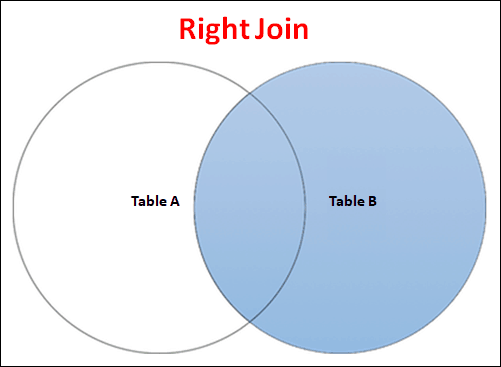
The circles in the above diagram represent the two tables. Table A and Table B, which we would like to join using the right join. The intersection part in the above picture shows the data rows which satisfy the join condition.
The right join of the above tables returns
- All the rows from the right table (i.e Table B )
- The matching rows from the left table (Table A )
Right Join Example
Now, let us see the join using a real-life example
Sample database
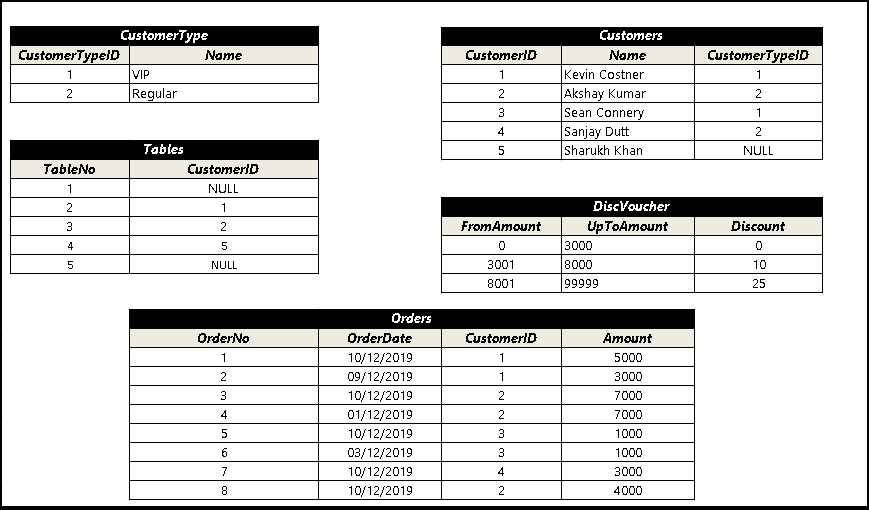
Consider the following tables from the table reservation system of a restaurant. You can use the following script to create the database.
CustomerType : Type of Customer like VIP / Regular etcCustomers List of customers with Customer Type.Tables The list of tables available in the restaurant. CustomerID field indicates that the customer has reserved the table.Orders : The orders placed by the customerDiscVoucher The discounts slab based on the total value of the order
[tabby title=”–Sample database–“]
[tabby title=”–SQL Query–“]
create table customerType (
 CustomerTypeID int primary key,
 Name varchar(10)
)

insert into customerType values (1,'VIP')
insert into customerType values (2,'Regular')


create table Customers (
   CustomerID int primary key,
   Name varchar(100),
   CustomerTypeID int null,
   CONSTRAINT FK_Customers_CustomerTypeID FOREIGN KEY (CustomerTypeID)
      REFERENCES customerType (CustomerTypeID)
);

insert into Customers values(1, 'Kevin Costner',1);
insert into Customers values(2, 'Akshay Kumar',2);
insert into Customers values(3, 'Sean Connery',1);
insert into Customers values(4, 'Sanjay Dutt',2);
insert into Customers values(5, 'Sharukh Khan',null);


create table Tables (
   TableNo int primary key,
   CustomerID int null,
   CONSTRAINT FK_Tables_CustomerID FOREIGN KEY (CustomerID)
      REFERENCES Customers (CustomerID)
);

insert into Tables values(1, null);
insert into Tables values(2, 1);
insert into Tables values(3, 2);
insert into Tables values(4, 5);
insert into Tables values(5, null);


create table Orders (
   OrderNo int primary key,
   OrderDate datetime,
   CustomerID int null,
   Amount decimal(10,2),
   CONSTRAINT FK_Orders_CustomerID FOREIGN KEY (CustomerID)
      REFERENCES Customers (CustomerID)
);

insert into Orders Values(1,'2019-12-10',1,5000)
insert into Orders Values(2,'2019-12-09',1,3000)
insert into Orders Values(3,'2019-12-10',2,7000)
insert into Orders Values(4,'2019-12-01',2,7000)
insert into Orders Values(5,'2019-12-10',3,1000)
insert into Orders Values(6,'2019-12-03',3,1000)
insert into Orders Values(7,'2019-12-10',4,3000)
insert into Orders Values(8,'2019-12-10',2,4000)

create table DiscVoucher (
   FromAmount decimal(10,0) ,
   UptoAmount decimal(10,0) ,
   Discount decimal(10,0)
)

insert into DiscVoucher Values(0,3000,0)
insert into DiscVoucher Values(3001,8000,10)
insert into DiscVoucher Values(8001,99999,25)
[tabbyending]
Query
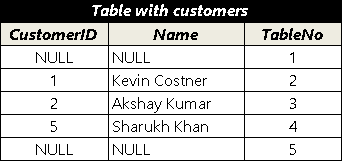
We would like to know the list of all customers, along with their reserved table No.
Select C.CustomerID,C.Name, T.TableNo
From Customers C
right join Tables T
on (C.CustomerID=T.CustomerID)
Since it is Right Join, the query returns all the Tables. But it returns the only the matching rows from the Customers.
Change the order of the tables appearing in the query i.e. exchanges customers & tables as shown below
Select C.CustomerID,C.Name, T.TableNo
From Tables T
right join Customers C
on (C.CustomerID=T.CustomerID)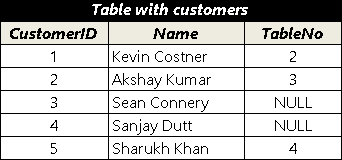
The results are different from the above. Now all the rows from tables are included in the result and only matching rows from the customers are included.
WHERE Condition
The WHERE clause will filter the rows after the JOIN has occurred
For Example in the following query, the join happens first. The Where filter is applied to the join result to get the final output. The result of the following query is similar to the inner join query.
Select C.CustomerID,C.Name, T.TableNo
From Customers C
Right join Tables T
on (C.CustomerID=T.CustomerID)
Where C.CustomerID is not null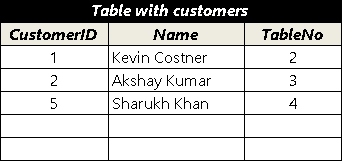
Right Join Examples
Here are some of the examples of Right Join
Subquery in Right Join
Select Cu.CustomerID,Cu.Name, Ord.Amount
From Customers Cu
Right join ( Select CustomerID, Sum(Amount) As Amount
       From Orders
	   Group by CustomerID) Ord
On (Cu.CustomerID= Ord.CustomerID)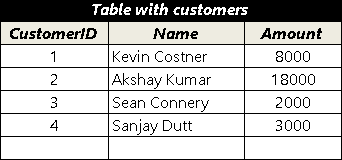
Multiple Conditions
Select Cu.CustomerID,Cu.Name, Ord.OrderDate, Ord.Amount
From Orders Ord
Right join Customers Cu
On (Cu.CustomerID= Ord.CustomerID and OrderDate='2019-12-10')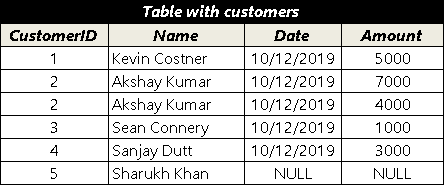
Join Operator other than equality
select Cu.CustomerID,Cu.Name, Ord.Amount, disc.Discount
From Customers Cu
Right join ( Select CustomerID, Sum(Amount) As Amount
       From Orders
	   Group by CustomerID) Ord
On (Cu.CustomerID= Ord.CustomerID)
join DiscVoucher disc
on ( ord.amount >= disc.FromAmount and ord.amount <= disc.UptoAmount)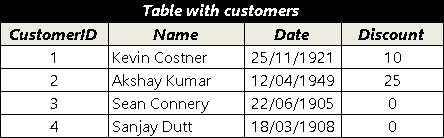
References
Summary
In this tutorial, we learned about how Right join works in SQL Server. And also looked at several examples of right join querries.